The growing surveillance state
The Trump administration is expanding the surveillance state—and facing pushback.


As someone who's been writing about surveillance and privacy rights for many years, I've been worried for some time about Donald Trump taking full advantage of the surveillance state that is available to him as president. Unfortunately, it seems that over the last year, the Trump administration has embraced surveillance as a tool for achieving its authoritarian goals.
Perhaps Americans are starting to take note of this, because there was recently a controversy surrounding Ring doorbell cameras that was actually pretty surprising. During the Super Bowl, Ring aired a commercial showcasing its new “Search Party” feature, which it claimed could utilize Ring cameras in a given neighborhood to help people locate a missing dog.
People quickly realized this looked like a tool of the surveillance state, and they started lambasting the company on social media. The ad caused enough controversy that social media accounts like WeRateDogs, which rates the cuteness of dogs, put out a video criticizing Ring.
As many observers noted, Ring has a history of handing over video footage to law enforcement, and it had recently entered into a partnership with a security technology company called Flock Safety that works with ICE. Because of the furor the new ad unleashed, Ring ended its relationship with Flock. That doesn't mean the company has stopped working with law enforcement, though.
Meanwhile, the Trump administration itself has been utilizing surveillance in many concerning ways. It was recently reported that the IRS has shared information on thousands of people with the Department of Homeland Security, which appears to be part of a broader trend of federal agencies sharing information with immigration enforcement in an unprecedented manner.
The State Department has used an AI program to scan the social media accounts of legal immigrants to look for political statements it disfavors. The federal government has expanded its definition of "domestic terrorism" to seemingly target activists and some nonprofits.
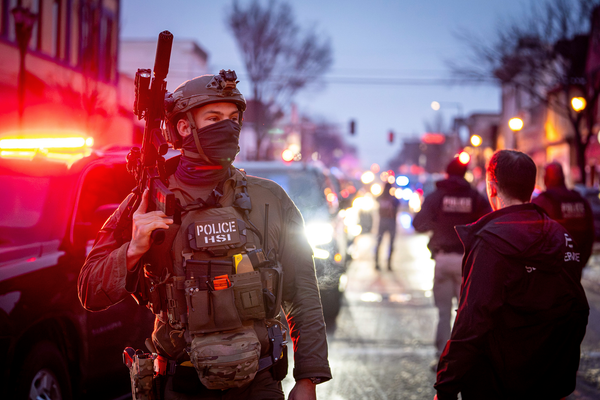
ICE and Customs and Border Protection have been using facial recognition software to identify activists, legal observers and others in cities like Minneapolis. Last month, an ICE agent in Maine took a picture of a legal observer's license plate and told her that she had been added to a database of domestic terrorists.
The New York Times just reported that DHS is trying to further scan the social media accounts of Americans to look for people who have been critical of ICE. I'd imagine they'll find a lot of people.
 Thor Benson
There are many more examples of this administration ramping up surveillance for its immigration crackdown and more. People are fighting back, though, and we've seen Americans utilizing apps to track and report ICE actions in various cities. That said, the Trump administration has a close relationship with Big Tech, and it's used that relationship to get apps like ICEBlock taken down from the Apple App Store.
Despite its efforts, people keep finding new ways to resist what is happening. One of the apps Minneapolis residents have relied upon for organizing is Signal, which is an encrypted messaging app. Kash Patel, the director of the FBI, says the agency is investigating those Signal chats.
It's going to be a cat-and-mouse game between the Trump administration trying to control the people and citizens finding new ways to share information and evade surveillance. That's just how these things tend to go. Everyone should be concerned, though, that the administration is using the latest technology to target its perceived political enemies and criminalize dissent.
If you're concerned about this, there are some things you should know about how to protect yourself. I recommend taking a look at guides from the Electronic Frontier Foundation (EFF) and Wired that explain how to protect your data when you're protesting or otherwise involved in political organizing.
Those of us who have been writing about surveillance for quite a while have been warning that America's surveillance state could be used by an authoritarian to violate people's First and Fourth Amendment rights and lock people up for behavior that was previously not seen as criminal. That's where we are now, and people need to understand that and learn how to stay safe in this changing environment.